
- You are here:
- Home »
- All Articles »
- Silver nitrate molar mass: How to calculate it, use it, and avoid common mistakes
Silver nitrate molar mass: How to calculate it, use it, and avoid common mistakes
Key Takeaways
Silver nitrate has a formula of AgNO₃ and a molar mass of about 169.87 g/mol. Once that value is clear, it becomes a simple bridge between mass, moles, solutions, and stoichiometric ratios.
- AgNO₃ contains one silver atom, one nitrogen atom, and three oxygen atoms.
- Its calculated molar mass is approximately 169.872 g/mol.
- Use grams-to-moles and moles-to-grams formulas carefully.
- Keep molarity, normality, and mass concentration separate.
- Silver nitrate requires appropriate laboratory handling, storage, and disposal.
What is the molar mass of silver nitrate?
The silver nitrate molar mass is the mass of one mole of AgNO₃ formula units. It is found by adding the atomic masses of every atom shown in the chemical formula. With commonly used standard atomic weights, the result is approximately 169.87 g/mol.
Chemical formula and composition of AgNO₃
Silver nitrate is written as AgNO₃. The formula contains one silver atom, one nitrogen atom, and three oxygen atoms; the subscript 3 applies only to oxygen. The compound is ionic, so “formula units” is the more precise term than molecules, although many introductory calculations use the word molecule loosely.
Standard atomic masses of silver, nitrogen, and oxygen
A periodic table commonly lists silver as 107.8682, nitrogen as 14.007, and oxygen as 15.999 atomic mass units. These values are numerically used as grams per mole when calculating a compound’s molar mass. A useful reference on the symbol Ag is the chemical symbol for silver, especially when distinguishing elemental notation from a compound formula.
Calculating the total molar mass step by step
The calculation follows the subscripts in AgNO₃: one silver contributes 107.8682 g/mol, one nitrogen contributes 14.007 g/mol, and three oxygen atoms contribute 3 × 15.999 = 47.997 g/mol. Adding those contributions gives 107.8682 + 14.007 + 47.997 = 169.8722 g/mol. In routine work, this is usually reported as 169.87 g/mol or 169.9 g/mol.
Reported value and appropriate significant figures
A database may report 169.872 g/mol, while a classroom exercise may expect 169.9 g/mol. Both can be appropriate when their rounding conventions are understood. The silver nitrate reference data is useful when a calculation needs a stated reference value rather than a rounded classroom value.
How to calculate silver nitrate molar mass
Finding the mass is mostly a matter of reading the formula accurately and keeping units consistent. The same method works for many ionic compounds, not just AgNO₃. Write the expression out rather than relying on mental arithmetic, particularly when a formula contains repeated or grouped atoms.
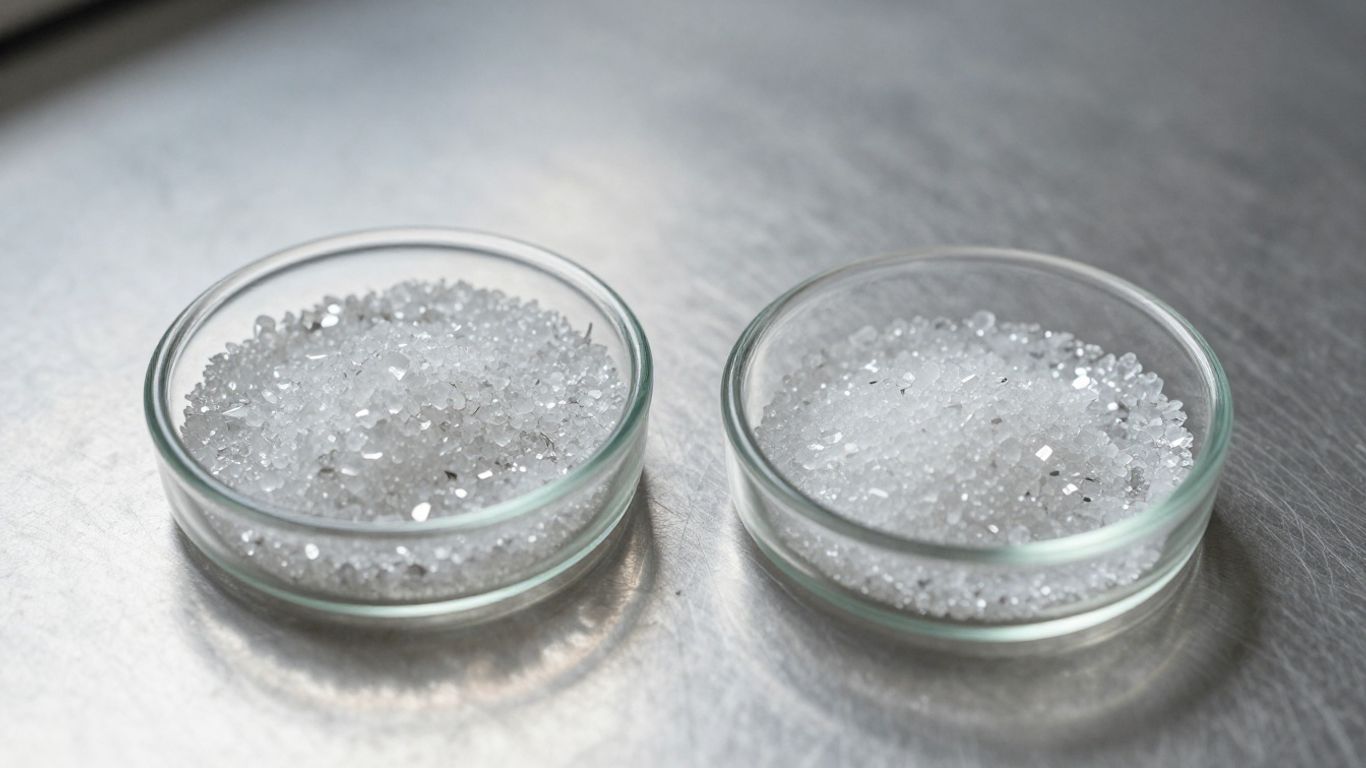
Multiplying each element by its subscript
Start by listing each element and its subscript. Silver has an implied subscript of 1, nitrogen also has an implied subscript of 1, and oxygen has a subscript of 3. Therefore, the expression is (1 × Ag) + (1 × N) + (3 × O).
Adding the elemental contributions
Using rounded values, the calculation is 107.87 + 14.01 + 48.00 = 169.88 g/mol. Using more digits before rounding gives 169.8722 g/mol. Keep extra digits during the calculation and round only the final answer; this avoids small errors later in concentration or stoichiometry work.
Checking the calculation with a periodic table
Before accepting the result, confirm that the table gives the intended atomic masses and that oxygen was multiplied three times. A quick independent check can compare the result with a step-by-step molar mass calculation. If the answer is near 121 or 186 g/mol, for example, a subscript or atomic mass was probably misread.
Understanding why atomic weights may vary slightly
Periodic-table values are weighted averages based on naturally occurring isotopes, so published values can differ in their last decimal place. Laboratory calculations normally use the values printed in the lab manual or the selected periodic table. Those small differences do not change the practical answer when it is reported to sensible significant figures.
Using silver nitrate molar mass in chemistry calculations
Once the molar mass is known, it becomes a conversion factor. The central relationship is moles = mass in grams ÷ molar mass, while mass = moles × molar mass. Keep the units visible at least once in each calculation so that an incorrect inversion is easier to spot.
Converting grams of AgNO₃ to moles
To convert a measured mass to moles, divide by 169.87 g/mol. For example, 16.987 g of AgNO₃ corresponds to 16.987 ÷ 169.87 = 0.1000 mol. The grams cancel, leaving moles, which can then be used in concentration or reaction calculations.
Converting moles to grams
To move in the other direction, multiply the amount in moles by 169.87 g/mol. Thus, 0.0250 mol requires 0.0250 × 169.87 = 4.24675 g, commonly reported as 4.25 g when the input has three significant figures. The properties and uses of silver nitrate provide useful broader context, but the numerical conversion itself comes from the formula and atomic masses.
Calculating the number of molecules or formula units
Multiply moles by Avogadro’s constant, 6.022 × 10²³ formula units/mol. For 0.100 mol of AgNO₃, that gives about 6.02 × 10²² formula units. Because silver nitrate is an ionic solid, formula units is the preferred description.
Applying the value in stoichiometric equations
In a balanced equation, the coefficient for AgNO₃ establishes its mole ratio with the other substances. Convert the starting mass to moles, use the coefficient ratio, and then convert the result into the requested unit. The molar mass belongs at the mass-to-mole boundaries, not in the coefficient ratio itself.
A chemistry problem can also involve a topic outside the calculation. For example, a health insurance deductible guide uses a different kind of cost accounting, while the chemistry conversion here always follows mass, moles, and formula units.
Silver nitrate molar mass in solution preparation
Solution preparation adds volume and concentration to the mass calculation. Molarity is defined as moles of solute per liter of solution, so the target volume must be expressed in liters. Accurate work also depends on the purity, hydration state, and calibration status of the material being used.
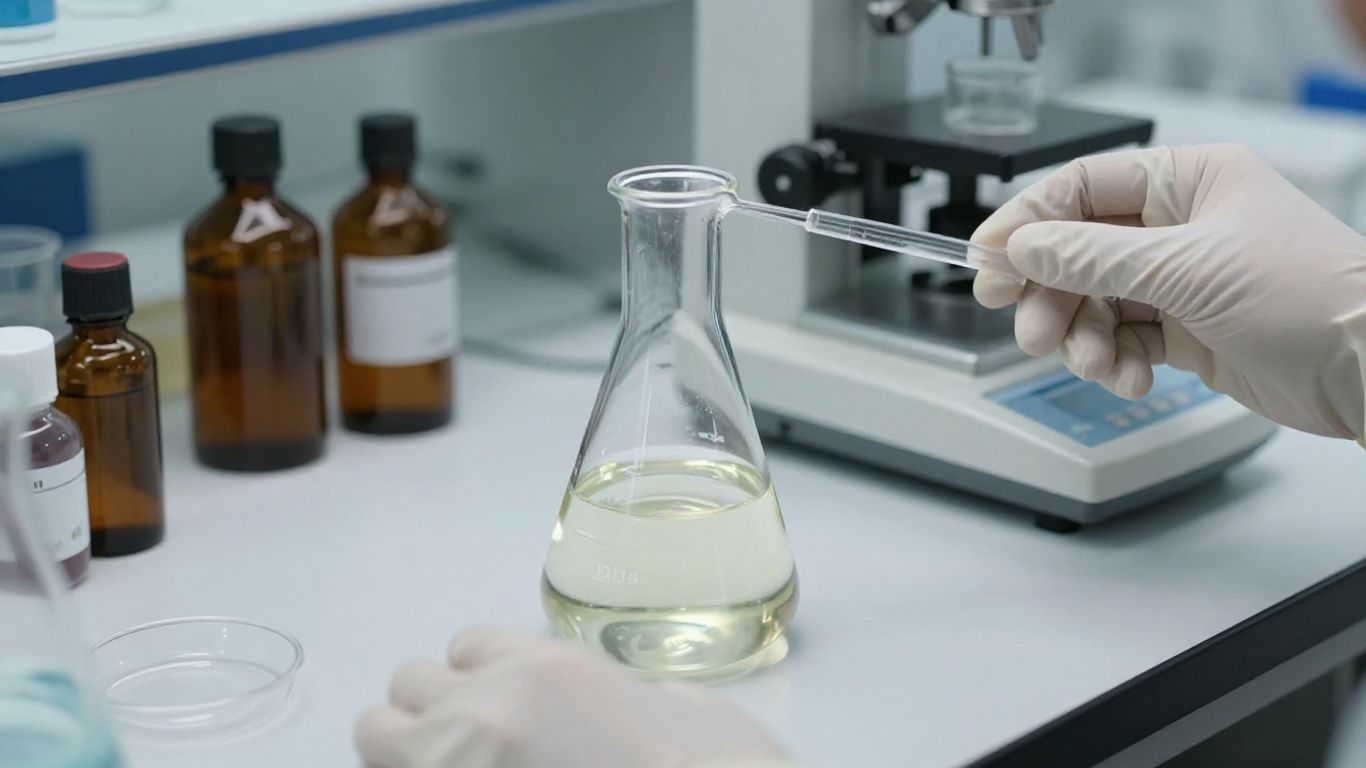
Preparing a solution with a target molarity
For a target molarity, first calculate moles with n = M × V. Then convert those moles to grams using 169.87 g/mol. Dissolve the calculated mass in a portion of solvent, transfer it to a volumetric flask, and dilute to the calibration mark according to the laboratory procedure.
Calculating the required mass for a given volume
For example, a 0.100 M solution with a final volume of 0.250 L requires 0.100 × 0.250 = 0.0250 mol. Multiplying by 169.87 g/mol gives 4.24675 g, or 4.25 g to three significant figures. The final volume is the volume of the solution, not simply the volume of water initially placed in the flask.
Understanding molarity, normality, and dilution
Molarity measures moles per liter. Normality depends on the reaction’s equivalent relationship, so its numerical value can depend on the intended titration or reaction. Dilution instead preserves solute amount and uses M₁V₁ = M₂V₂; it does not change the molar mass of AgNO₃.
Using volumetric-grade silver nitrate solutions
Ready-made volumetric solutions can reduce weighing and dissolution work when their stated concentration and traceability fit the method. A standard silver nitrate solution is described for volumetric laboratory use, while another 0.01 M silver nitrate solution is listed for analytical applications. Always check the certificate, concentration, expiry information, and laboratory instructions before use.
A different kind of evidence-based calculation appears in marketing mix modeling, where aggregate inputs are used to estimate contributions. The comparison is only methodological: chemical concentration still requires direct mass-and-volume accounting.
Common mistakes when finding silver nitrate molar mass
Most errors are not difficult chemistry errors; they are reading, unit, or rounding errors. A short pause before calculating often catches them. It helps to write the formula, atomic masses, multiplication, and final unit in separate lines.
Confusing silver nitrate with other silver compounds
Silver nitrate is AgNO₃, not silver oxide, Ag₂O, or another silver-containing compound. Changing the anion changes both the atom count and the molar mass. A guide to silver oxide properties illustrates why the compound name must be matched to the exact formula before any arithmetic begins.
Misreading the AgNO₃ subscripts
Ag and N each have an implied subscript of 1, while O has a subscript of 3. The 3 does not apply to nitrogen, and it does not multiply the entire formula. Parentheses would be needed to indicate a repeated polyatomic group, but there are no parentheses in AgNO₃.
Using an incorrect atomic mass for silver
Silver’s atomic mass is about 107.87, not 108.87 or 47.87. When checking a result, silver should make up most of the total because it is the heaviest single contribution. The silver nitrate chemical data can serve as an external reference for identifying the compound before comparing numerical values.
Rounding too early in multi-step calculations
Rounding 169.872 to 170 may be acceptable for a rough estimate but can distort a precise solution preparation. Keep the calculator’s digits through intermediate steps and round the final reported quantity to match the measured data. This is especially useful when several conversions are chained together.
Mixing mass concentration with molar concentration
Mass concentration might be written in g/L, whereas molarity is mol/L. To convert g/L into mol/L, divide by 169.87 g/mol; to reverse the conversion, multiply. Writing the units beside every number makes the distinction much harder to miss.
For perspective, even a magnesium supplement evidence review depends on separating a chemical quantity from a health claim. Here, the safe habit is the same: define the quantity before interpreting the number.
Practical examples and safety considerations
A worked example shows how the pieces fit together, but the arithmetic is only one part of laboratory practice. Silver nitrate can stain skin and surfaces and should be handled according to the relevant safety data sheet. The right concentration, container, labeling, and waste route matter as much as the calculated mass.
Worked example for a 0.100 M AgNO₃ solution
To prepare 100.0 mL of 0.100 M AgNO₃, convert the volume to 0.1000 L. The required amount is 0.100 mol/L × 0.1000 L = 0.01000 mol. Multiplying by 169.87 g/mol gives 1.6987 g, so 1.699 g is a reasonable reported mass when the balance and target specifications support four significant figures.
The practical sequence is easiest to follow when written as a short checklist:
- Weigh the calculated mass using suitable laboratory equipment.
- Dissolve it in less solvent than the final target volume.
- Transfer quantitatively into a calibrated volumetric flask.
- Dilute to the mark, mix thoroughly, and label the solution.
This sequence separates the calculation from the final-volume adjustment. It also reduces the chance of treating the initial solvent volume as the finished solution volume.
Determining the mass in a laboratory sample
If a sample contains 0.00500 mol of AgNO₃, its mass is 0.00500 × 169.87 = 0.84935 g, or 0.849 g to three significant figures. If the sample’s mass is known instead, divide by 169.87 to find the amount in moles. The direction of the conversion should always match the unit you start with.
Handling silver nitrate safely
Wear appropriate eye protection, gloves, and a laboratory coat, and avoid contact with skin and eyes. Keep the solid and solutions away from incompatible materials and clean spills using the approved institutional procedure rather than improvising. The broader silver nitrate safety guide discusses handling, light sensitivity, and different purity grades.
Storing and disposing of silver nitrate properly
Store silver nitrate in a properly closed, clearly labeled container, following the supplier’s safety information and local laboratory rules. Protect it from unsuitable light and incompatible substances where the procedure requires it. Do not pour unused material into a drain; collect it through the designated chemical-waste system.
One final comparison may help readers who encounter technical subjects beyond chemistry: neutral-atom quantum computing also depends on precise counting and controlled conditions, but it does not change the calculation for AgNO₃. Precision begins with using the right formula for the right task.
Conclusion
The silver nitrate molar mass is approximately 169.87 g/mol, obtained by adding one silver, one nitrogen, and three oxygen contributions. From there, careful unit handling turns the value into a reliable tool for converting samples, preparing solutions, and applying stoichiometric ratios. Keep the formula visible, delay rounding, and pair sound arithmetic with sensible laboratory safety.
Frequently Asked Questions
What is the molar mass of silver nitrate?
The commonly reported molar mass of AgNO₃ is 169.87 g/mol, sometimes rounded to 169.9 g/mol.
What is the formula for silver nitrate?
The chemical formula is AgNO₃: one silver atom, one nitrogen atom, and three oxygen atoms.
How do you convert grams of silver nitrate to moles?
Divide the mass in grams by 169.87 g/mol. The result is the amount in moles.
How do you convert moles of silver nitrate to grams?
Multiply the amount in moles by 169.87 g/mol to obtain mass in grams.
Is silver nitrate molecular or ionic?
Silver nitrate is an ionic compound, so formula unit is the more precise term for its basic units.
How much silver nitrate is needed for a molar solution?
Use mass = molarity × volume in liters × 169.87 g/mol. Make sure the volume is the final solution volume.
Why can published molar masses differ slightly?
Different periodic tables may display slightly different atomic-weight precision. The difference usually affects only the last reported decimal place.
Related Posts
Silver Wings Colloidal Silver: Uses, Safety, and What to Know
Chemical element silver: Properties, uses, history, and why it matters
Colloidal silver liquid 250 ppm: Uses, safety, quality, and what to know before buying
A complete guide to 950 silver: what it is and how it compares to sterling
How to use a colloidal silver generator safely and effectively
How to buy colloidal silver: A guide to quality and safety
Understanding colloidal liquid silver: uses, safety, and evidence
Colloidal silver uses: a comprehensive guide on safety and application
